Astrophysicist  ·  Dark Matter  ·  Galactic Dynamics

Arpit Arora

Moore Foundation Fellow

Postdoctoral Scholar, Department of Astronomy
University of Washington  ·  Seattle, WA

Scroll

Hi, I'm Arpit.

Arpit Arora
Moore Foundation Fellow UW Astronomy Dark Matter

I am an astrophysicist and Moore Foundation Fellow at the University of Washington, working at the intersection of dark matter physics and galactic dynamics. Originally from New Delhi, India, I completed my Ph.D. at the University of Pennsylvania (2024) after receiving my B.S. from the University of Minnesota.

My research treats the Milky Way as a laboratory for dark matter. By combining zoomed cosmological hydrodynamical simulations with dynamical tools built for the disequilibrium regime, I model the asymmetric distribution of dark matter and probe alternative models — including self-interacting and atomic dark matter. I am currently focused on stellar streams and what they reveal about the distribution and particle properties of dark matter.
2024 — Moore Foundation Fellow, Postdoctoral Scholar · University of Washington
2024 Ph.D. Astrophysics · University of Pennsylvania, Philadelphia
2019 B.S. Physics & Astrophysics · University of Minnesota, Minneapolis

Research Highlights

Using the Milky Way as a dark matter laboratory — combining cosmological simulations, dynamical modelling, and stellar tracers to illuminate how dark matter shapes our Galaxy and what its particle nature leaves behind.

Shaping the Milky Way simulation
Galactic Dynamics ApJ 2025

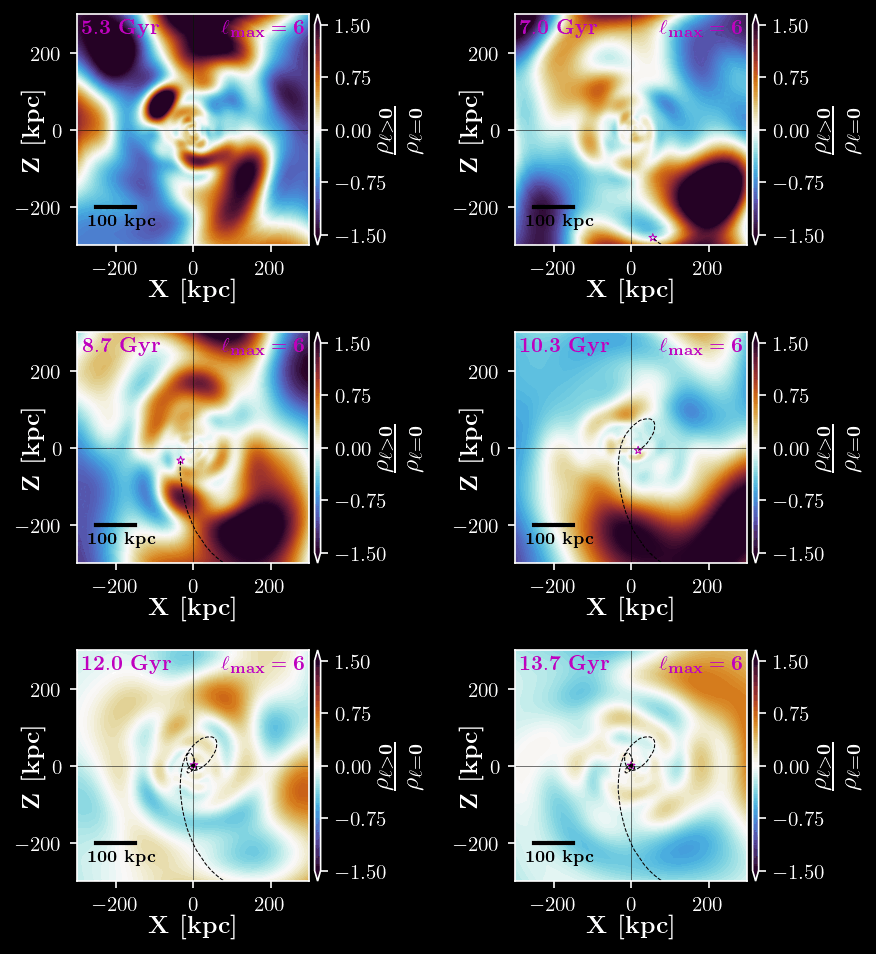
Shaping the Milky Way: Mergers & Cosmic Filaments

Dynamical models to characterize the disequilibrium distribution of dark matter in the Milky Way, tracing the interplay of merger history and large-scale cosmic filament accretion.

Read Paper
Stellar streams
Stellar Streams In Prep

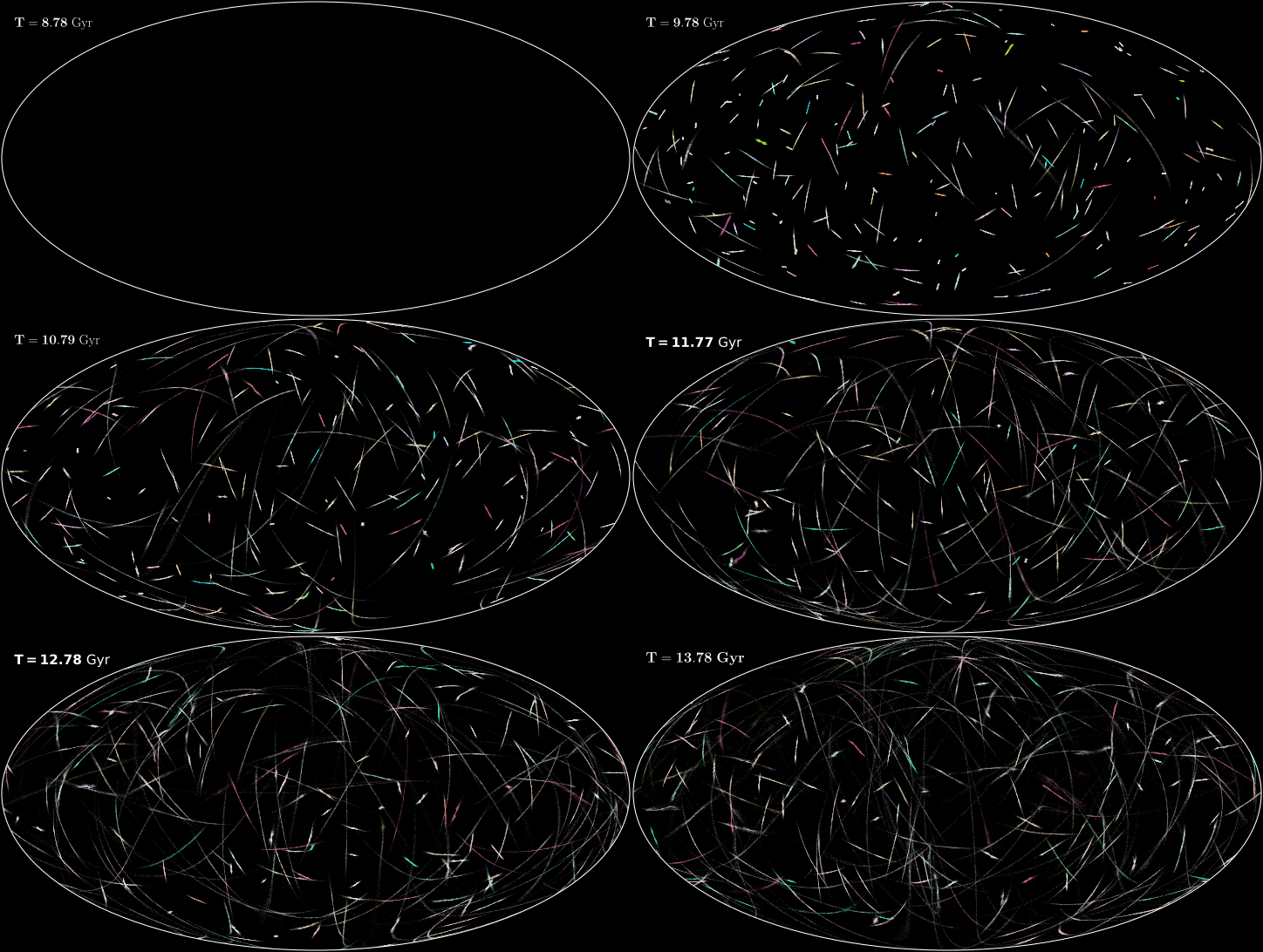
Stellar Streams in a Time-Evolving Milky Way

Evolution of stellar streams — tidal remnants of disrupted satellite galaxies — in realistic, time-dependent Milky Way potentials from zoomed cosmological hydrodynamical simulations.

In Preparation
Alternative dark matter
Dark Matter Models ApJ 2024

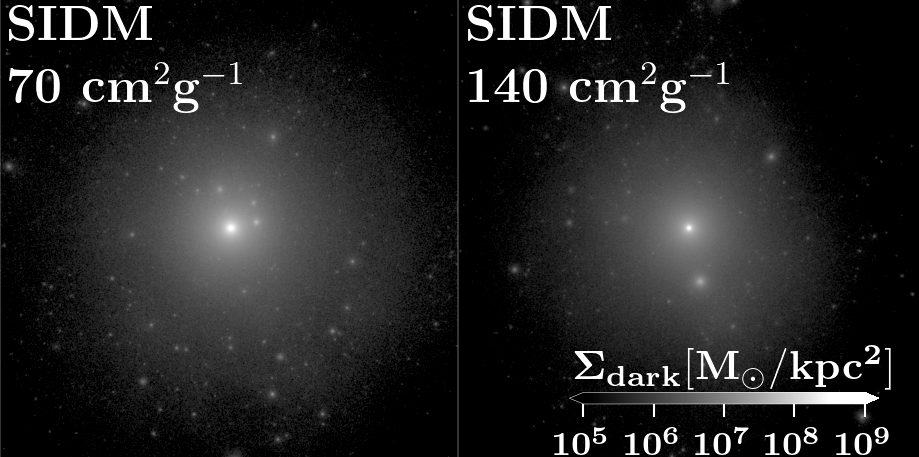
Self-Interacting & Atomic Dark Matter

Probing alternative dark matter models — self-interacting and atomic dark matter — through their distinct observational signatures in the kinematics of Milky Way satellite galaxies and stellar stream morphology.

Read Paper

Selected Publications

Full list on SciX, ORCID, and Google Scholar.

In Prep
Evolution of Stellar Streams in Realistic Time-Dependent Milky Way Potentials
In Preparation  ·  Arora, A. et al.
In Prep
2025
The Astrophysical Journal  ·  Arora, A. et al.
ApJ
2024
ApJ
2024
ApJ
2022
ApJ 939, 2  ·  Arora, A. et al.
ApJ

Interactive Science

Open tools for exploring the geometry and physics of stellar stream encounters and high-performance N-body simulation of tidal disruption.

Interactive 3D

Stream–Subhalo Impact Geometry

Interactive 3D visualization of the geometry of a dark matter subhalo impacting a stellar stream. Explore impact angle ψ, velocity angle θ, basis vectors, and relative velocities in real time via Plotly.

Launch Tool
Open Source

Nbody_streams

Run N-body simulations of stellar streams in isolation or in an external potential using highly efficient CUDA kernels — supporting both direct N-body and tree codes, plus analysis utilities.

View on GitHub

Curriculum Vitae

Moore Foundation Fellow University of Washington Ph.D. UPenn 2024

My full CV includes a complete publication list, conference talks, teaching, and service activities.

Download CV (PDF)

Get in Touch

Always happy to discuss dark matter, stellar streams, simulations, or potential collaborations.